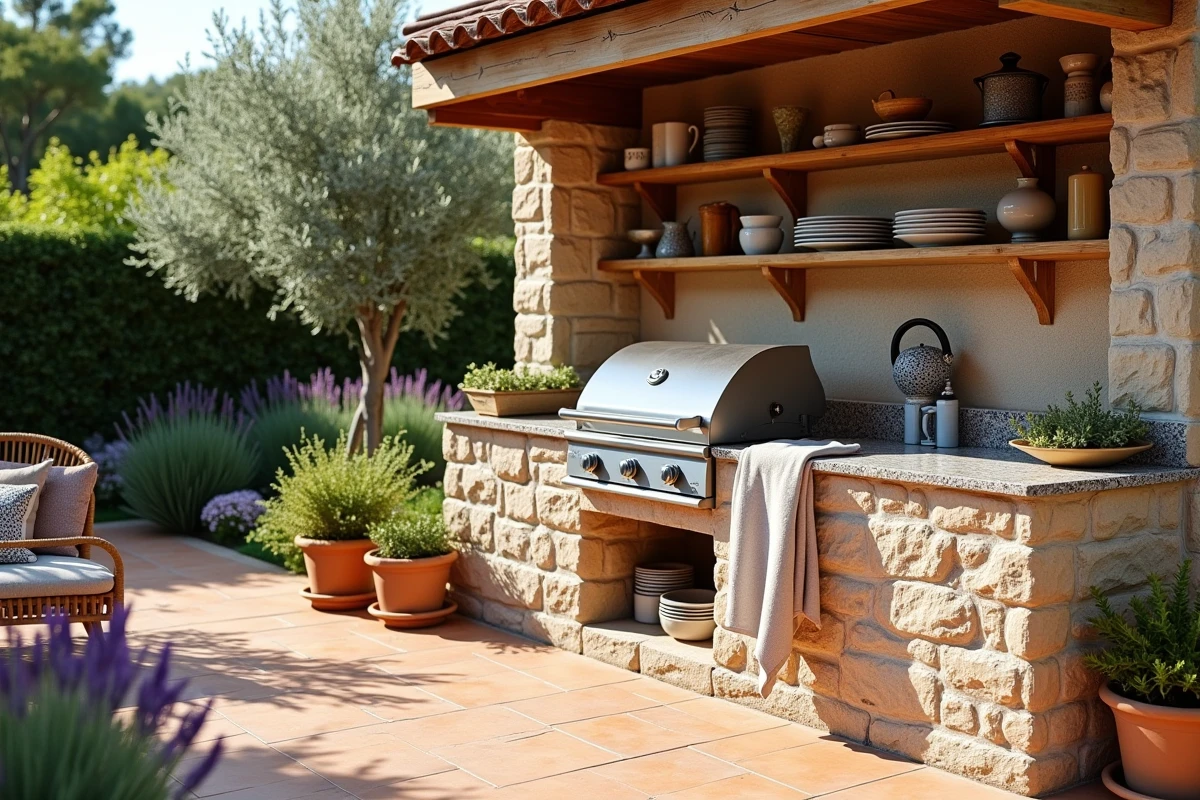
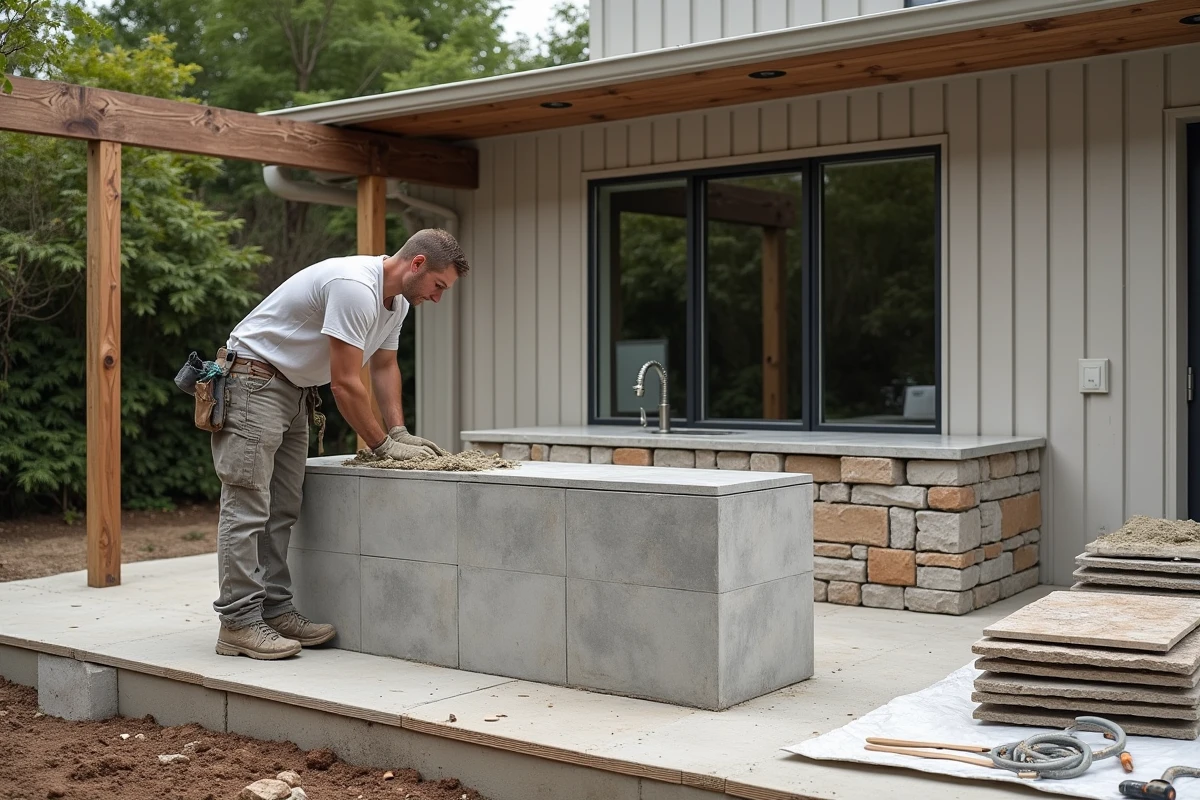
A stone countertop is installed, a sink connected to the network, a pergola above to protect everything, and the summer kitchen takes shape in just a few weekends. The problem arises later, often by mail: a notice of development tax or a formal notice from the town hall. The line between a simple garden layout and a construction subject to declaration and then taxation depends on specific technical criteria.
Ground footprint and taxable area: two concepts that most property owners confuse
The most common trap when setting up an outdoor kitchen is mixing what falls under urban planning (should it be declared?) and what falls under local taxation (will we have to pay a tax?). These two questions rely on different calculations.
The ground footprint corresponds to the vertical projection of the construction on the land. It determines whether the project requires a prior declaration or a building permit, according to the thresholds set by the Urban Planning Code. However, the ground footprint does not serve as a basis for calculating the development tax.
The taxable area, on the other hand, is measured within the walls of a space that meets two cumulative conditions: it must be enclosed and covered, with a ceiling height of at least 1.80 m. Only this area is included in the taxable base for the development tax. A property owner who has addressed the issue of summer kitchens and taxation before starting their project avoids most unpleasant surprises.
In practice, an outdoor kitchen open on one or more sides, even covered by an awning or a pergola, does not create a taxable area. Therefore, one may be required to submit a prior declaration to the town hall without necessarily having to pay the development tax. The reverse is not true: any taxable area requires prior urban planning authorization.

Open, covered, or closed summer kitchen: tax consequences depending on the configuration
The tax status of the summer kitchen directly depends on its degree of enclosure. Three scenarios are distinguished, and the consequences vary radically from one case to another.
Open configuration without fixed roofing
A masonry barbecue, a concrete countertop, a sink placed on a slab: as long as there are no walls or rigid covering, we remain in the realm of simple outdoor layout. No floor area is created. No declaration, no development tax, no impact on property tax.
Covered configuration but open on at least one side
This is the most common case: a kitchen installed under a pergola attached to the house or under a wooden awning. The covering creates a ground footprint, which may trigger a prior declaration obligation depending on the area concerned. However, since the space is not enclosed, it does not generate a taxable area in the fiscal sense. Therefore, the development tax does not apply to this part.
Closed and covered configuration
As soon as the summer kitchen is surrounded by walls or fixed partitions on all sides and has a roof, it falls into the category of closed and covered constructions. The area created then enters into the calculation of the development tax and may also modify the cadastral rental value, with a potential impact on property tax.
This scenario generates the most adjustments among individuals, often because the complete enclosure of the space was done afterward, without a new declaration.
Prior declaration or building permit for an outdoor kitchen: urban planning thresholds
The formalities depend on the ground footprint and the created floor area. The Local Urban Plan of the municipality may modify certain thresholds, but the general framework remains as follows:
- Below a certain area (generally around a few square meters), no formalities are required for a non-enclosed and non-covered layout.
- Beyond that, and up to an intermediate threshold, a prior declaration of works is sufficient. This applies to most summer kitchens covered by a pergola or awning.
- Once the upper threshold set by the PLU is exceeded (which may vary by area), a building permit becomes mandatory. This case mainly concerns large-scale projects or fully enclosed summer kitchens that resemble an extension of the house.
The PLU may also impose constraints on materials, colors, distance from property boundaries, or maximum height. It is recommended to consult the urban planning department of the town hall before starting work, even for a project that seems modest.
Property tax and rental value: the risk of an undeclared layout
Beyond the development tax (paid once after construction), a closed and covered summer kitchen can also affect property tax in the long term. The mechanism is indirect: the new construction modifies the living area or the characteristics of the property, leading to a revision of the cadastral rental value by the tax administration.
In practice, feedback varies on this point. Some municipalities conduct consistency checks between aerial photos and submitted declarations. Others rely on work declarations transmitted by urban planning services to the tax authorities. In both cases, a layout carried out without declaration and detected afterward exposes the owner to a property tax reassessment along with penalties.
The riskiest case remains that of a summer kitchen initially open, then gradually closed by glass walls or roller shutters. This shift transforms a non-taxable space into a closed and covered area, without the owner having thought to carry out a new procedure. Regularization is still possible, but it involves submitting a declaration to the town hall and notifying the property tax center of the change.
Keeping the summer kitchen open on at least one side remains the simplest configuration from a tax perspective. It limits urban planning formalities to the strict minimum and does not create any taxable area. For those who wish to completely enclose the space, anticipating the declaration and incorporating the tax cost into the project budget avoids unpleasant surprises several months after the end of the work.