The interior decoration market in 2026 is no longer just about choosing a palette from a generic color chart. Two underlying movements are reshaping choices: regulations on furniture reuse and the territorial anchoring of colors. These axes, still little exploited by traditional inspirational articles, are fundamentally changing the way to design an interior with style and originality.
REP furniture sector: what the regulations change for your interior decoration
The specifications of the REP furniture sector for 2024-2029 strengthen the objectives of repair, reuse, and recycling. Three eco-organisms have been approved since 2024: Ecomaison, Valdelia, and Valobat. This structuring is not an administrative detail; it transforms the available offer for anyone wishing to decorate differently.
Furniture reuse is rapidly structuring itself in France. Resource centers, refurbishment platforms, and professionalized second-hand circuits now offer verified pieces, sometimes restored according to standardized criteria. We observe that this sector generates a stock of unique furniture that cannot be reproduced in series.
From a decorative standpoint, this opens up a rarely addressed avenue: decorating with refurbished furniture or items from resource centers is no longer a matter of DIY. The available pieces range from restored Art Deco dressers to 1960s Scandinavian armchairs, with increasing traceability. To explore decor inspirations on Design en Ville, this intersection between creation and reuse constitutes a particularly fertile ground.
Criteria for selecting reused furniture for a decor project
- Check the eco-organization affiliation of the seller (Ecomaison, Valdelia, or Valobat) to ensure the compliance of the circuit
- Prefer pieces whose load-bearing structure is intact, even if the covering requires textile intervention
- Match the style of the furniture with the existing architecture of the space: a 1950s sideboard interacts better with solid wood flooring than with recent laminate flooring
Colors anchored in a territory: going beyond the trendy color chart
Color in decoration is moving away from universal palettes dictated by paint manufacturers. A study by Airbnb-IFOP reported by Le Journal de la Maison in October 2026 shows that color is becoming a territorial marker. The favored shades vary according to the most sought-after French regions: coastal, wine-growing, mountainous landscapes.
Concretely, this means that the choice of a wall color benefits from being based on the identity of the place rather than on a global trend. An interior by the Atlantic coast does not call for the same greens as a house in Burgundy. We recommend starting from the landscape visible from the windows, then moving towards the interior palette.
Putting a local palette into practice
Photographing the natural light in your room at three different times of the day remains the most reliable gesture before choosing a color. A gray-blue suitable for the Breton sky will turn dull in a south-facing room in Provence.
Natural pigments and mineral-based paints (lime, clay) capture this local light much better than satin synthetic paints. The matte finish and micro-texture they produce catch light unevenly, which enhances the visual anchoring in the environment.
Textiles without PFAS and natural fibers: a decor choice that has become technical
Sustainability in decoration is no longer limited to a marketing label. Regulations encourage prioritizing untreated textiles without PFAS (per- and polyfluoroalkyl substances), these chemical compounds that have long been used for waterproofing upholstery fabrics. This evolution encourages the selection of natural fibers for curtains, cushions, and coverings right now.
Linen, hemp, and untreated wool offer technical properties often superior to chemical treatments for indoor use. Linen naturally regulates ambient humidity. Hemp resists UV without additives. These materials provide a texture that enriches the creation of ambiance far beyond the simple choice of color.
Combining natural fibers and reused furniture
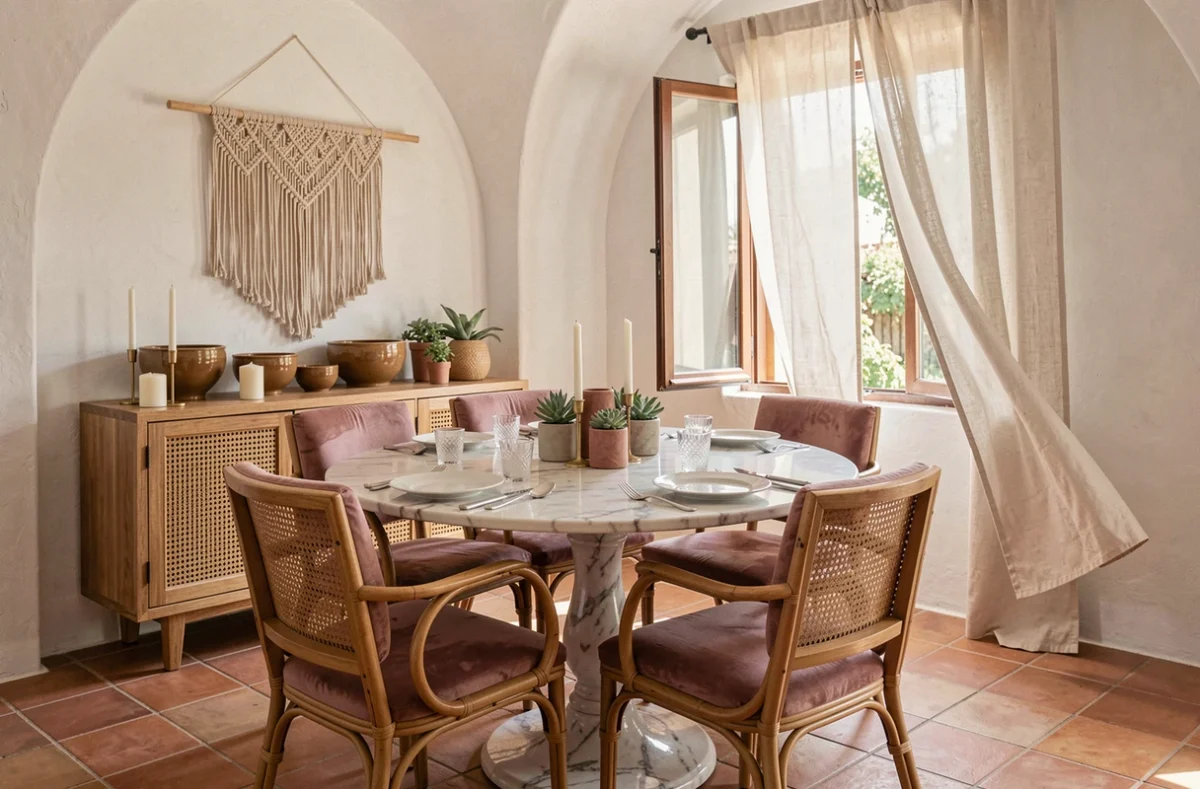
The combination works particularly well visually. A vintage 1970s armchair, reupholstered in raw linen, acquires contemporary coherence without losing its original character. The assembly of raw materials and antique pieces creates a visual tension that standard new furniture does not produce.
- Washed linen cover on a vintage seat: the contrast between the wood’s patina and the textile’s softness generates depth
- Unbleached hemp curtain in front of an old mullioned window: the filtered light produces a grain that synthetic sheers flatten
- Looped wool cushion placed on a reclaimed solid wood bench: the roughness of the two materials responds to each other without neutralizing
Multifunctional furniture in small spaces: a constraint that becomes a decor choice
Homes with constrained surfaces require furniture capable of serving multiple purposes. Consumer research confirms this: the demand is for pieces that combine storage, seating, and work surfaces. A piece of furniture that fulfills three functions frees up floor space and simplifies the visual reading of the room.
Storage benches, extendable tables with drop-leaf tops, consoles that transform into desks: these typologies have long existed in design. Their current interest lies in the increasing quality of mechanisms and materials available, including in the reuse market.
The common pitfall remains to multiply multifunctional furniture to the point of creating an entirely utilitarian interior. We recommend limiting these pieces to two or three per living space and visually anchoring them with a purely decorative object, a ceramic, a raw stone, a locally crafted piece, which serves no other purpose than to exist.
Interior decoration in 2026 plays out at the intersection of regulations, territory, and material choices. Selecting a textile based on its chemical composition, choosing a color dictated by a local landscape, integrating furniture from a structured reuse sector: these technical gestures produce interiors that are more unique than any trend imported from an international fair.