Equipping a kitchen often means accumulating utensils without really knowing which ones make a difference on a daily basis. Between a frying pan with a questionable coating and a knife that no longer cuts after six months, the performance gaps between two similarly priced items can sometimes be spectacular. This article compares the materials and categories of utensils that truly matter for successful recipes, based on measurable criteria.
Frying Pan Coatings: PTFE, Ceramic, or Cast Iron, How Do They Really Compare?
| Coating | Thermal Conductivity | Average Lifespan | Maintenance | Point of Caution |
|---|---|---|---|---|
| PTFE (Teflon) | Very good, heats quickly and evenly | Several years (depends on usage) | Easy, avoid metal utensils | Legal in the EU, but check the exact material of the coating |
| Ceramic | Good, slightly less reactive | Shorter if frequently overheated | Easy, sensitive to thermal shocks | May contain other PFAS despite the “PFOA-free” claim |
| Raw Cast Iron | Slow to heat, excellent inertia | Several decades | Regular seasoning, no dishwasher | Heavy weight, unsuitable for quick movements |
| Stainless Steel | Variable depending on the base (tri-ply recommended) | Very long | Can stick without fat | Requires a preheating technique |
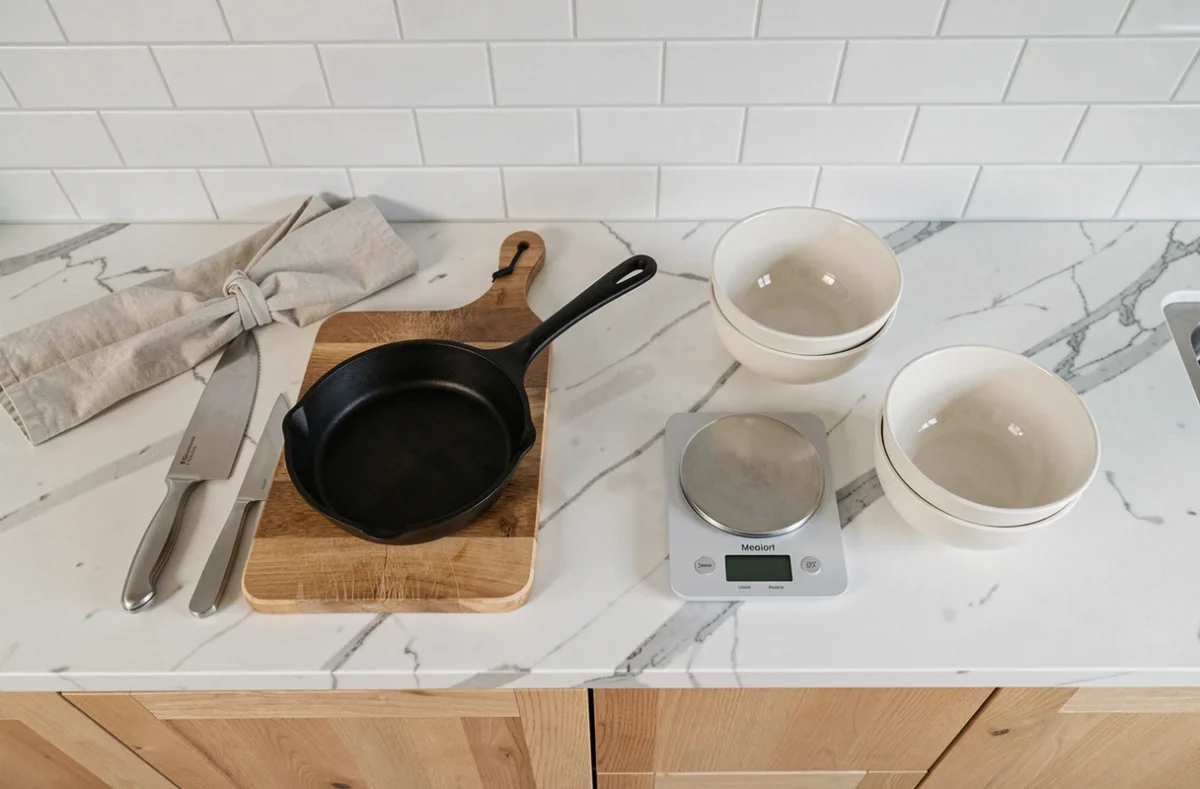
The table highlights a often overlooked point: the lifespan of a frying pan depends more on the coating than on the displayed price. A well-maintained cast iron pan will last for decades, while a budget ceramic pan will lose its non-stick properties after just a few months of intensive cooking.
The mention of “PFOA-free” on a non-stick pan deserves careful examination. PFOA has been banned in the European Union since 2020, making this marketing claim rather non-discriminatory. In contrast, other PFAS like GenX remain under scrutiny and may be present in the manufacturing process. To choose wisely, it’s better to look for the exact composition of the coating rather than relying on a marketing label.
To delve deeper into the topic and compare the available ranges, the kitchen equipment sheets on Yummy Blog detail the technical characteristics by material category.
Kitchen Knife: Blade Material and Sharpening Angle
Competitors often list three knives that one should own. The more useful question is to understand why two knives at the same price cut differently after a few weeks.
Carbon steel retains its sharpness longer than standard stainless steel, but it oxidizes when in contact with moisture and acidic foods. Stainless steel, on the other hand, resists corrosion while requiring more frequent sharpening. So-called “semi-stainless” or high-carbon steels attempt to combine both advantages, with variable results depending on the manufacturers.
The Sharpening Angle: An Underestimated Criterion
A European paring knife is generally sharpened between 20 and 25 degrees per side. Japanese knives often go below 15 degrees, which gives a finer edge but also a more fragile one. Using a Japanese knife to debone poultry means forcing a blade that is not designed for that lateral effort.
- For cutting vegetables and herbs, a finely angled chef’s knife offers superior precision and is less tiring on the wrist.
- For versatile tasks (meat, fish, hard vegetables), a chef’s knife with a standard angle remains the safest choice.
- A honing steel made of steel or ceramic, used before each session, prolongs the sharpness much more effectively than occasional sharpening.
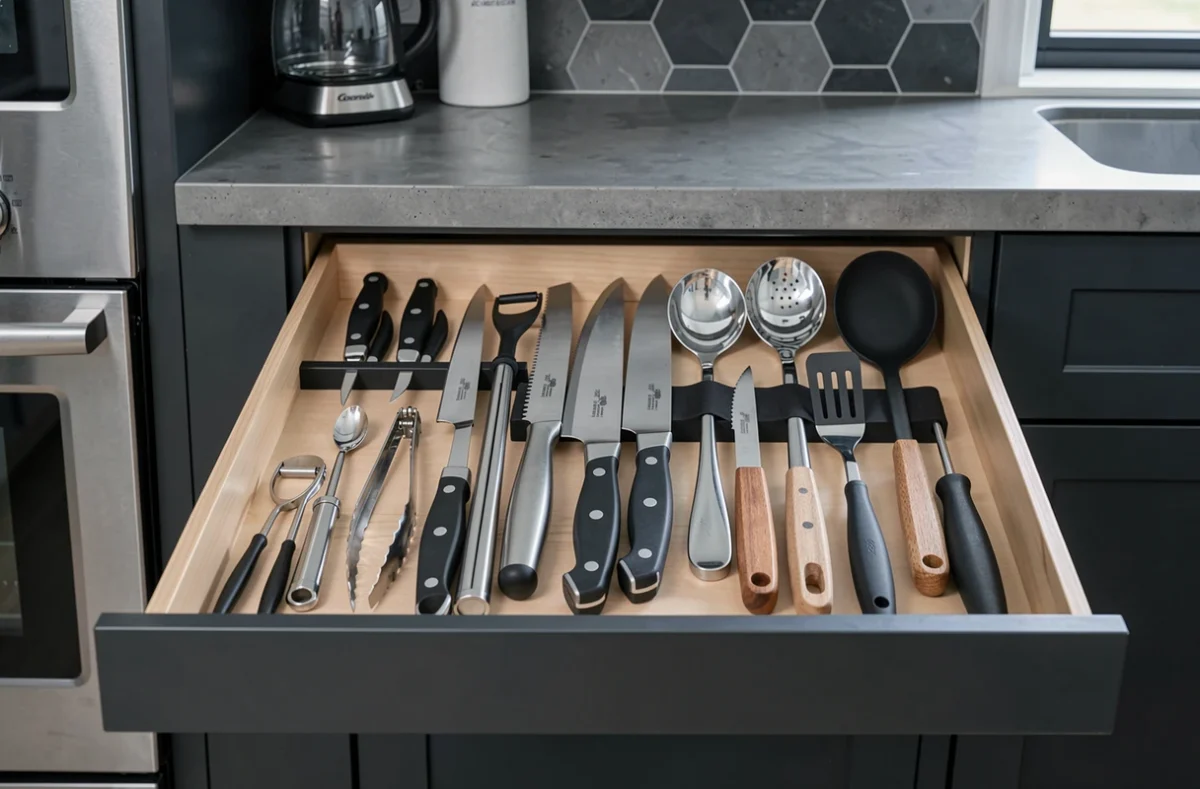
A well-maintained knife makes half of the cutting gadgets we accumulate in drawers unnecessary.
Scale, Spatula, and Strainer: Utensils Where Quality Changes the Result
Some accessories seem interchangeable. In practice, differences in precision or thermal resistance have a direct impact on the final result.
Kitchen Scale: Graduation and Reactivity
A scale that displays to the nearest gram allows for precise proportions in baking, where a few grams of yeast or flour can change the texture. Models with five-gram graduations are sufficient for savory dishes but become a hindrance when tackling precision recipes.
Spatula and Thermal Resistance
A food-grade silicone spatula withstands high temperatures without deforming or releasing compounds into the preparation. In contrast, low-quality plastic spatulas degrade with heat and contaminate dishes. Checking the maximum temperature indicated by the manufacturer helps avoid this pitfall.
Strainer and Size of Perforations
To drain vegetables or pasta, a strainer with large perforations is sufficient. To rinse rice, lentils, or herbs, a fine sieve is necessary. Having both prevents losing half of the ingredients down the sink.
Cooking Materials and Health: What Regulations Really Cover
French law n° 2025-188 of February 27, 2025, targets certain products containing PFAS, including cosmetics, ski wax, and certain textiles. Frying pans and kitchen utensils are excluded from this regulation. PTFE remains legal in the European Union, and no specific ban currently targets non-stick coatings.
This situation creates a gap between consumer perception and the actual legal framework. Many brands communicate about the absence of PFOA without specifying that this substance has been banned since 2020. The relevant criterion for comparing cooking utensils remains the complete composition of the coating, not a reassuring logo on the front.
The durability index, which complements the reparability index since 2025, does not yet cover kitchen equipment like ovens or refrigerators. No official score currently allows for comparing the longevity of utensils on a standardized basis. The choice still relies on materials, brand, and user experience.
Well equipping your kitchen does not require an unlimited budget or a drawer overflowing with accessories. A well-sharpened chef’s knife, a frying pan with a known exact coating, a precise scale, and a few utensils made from durable materials cover the vast majority of recipes. The rest is often just marketing noise.