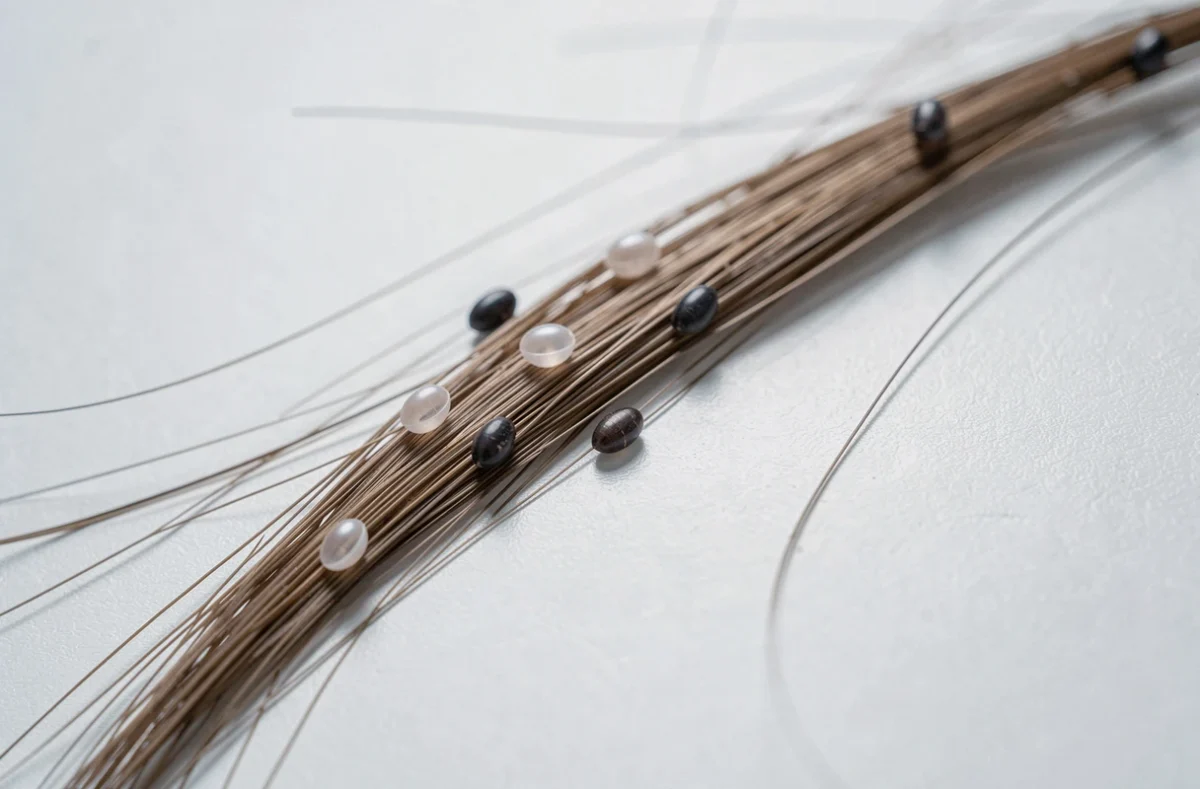
After an anti-lice treatment, the question inevitably arises: are the parasites found in the comb really dead? The answer determines the next steps in management, between simple monitoring and reapplication of the product. Reliable criteria rely on direct observation of the color, mobility, and position of the nits on the hair.
The crack under the nail: what this sound really indicates
The idea is persistent: crushing a louse between two nails and hearing a little “crack” would prove it was alive, while a dead louse would produce no sound. This belief is based on a confusion between the physical structure of the insect and its vital state.
A louse, whether dead or alive, has a chitinous exoskeleton. This small mechanical noise occurs when this rigid shell gives way under pressure. The presence or absence of cracking mainly depends on the size of the insect, its stage of development, and the force applied, not on its state of life. A recently hatched nymph, even if alive, produces almost no perceptible sound.
In other words, the cracking is not a reliable indicator of the louse’s state. Basing the decision for re-treatment on this sole criterion exposes one to two symmetrical errors: considering a dead louse as alive (and re-treating unnecessarily) or, worse, considering a living louse as dead because it did not crack.
To know how to recognize dead lice without relying on this kind of approximate test, one must turn to visual and behavioral criteria that can be verified with the naked eye.

Color and mobility of the louse: the two field criteria
Direct observation remains the safest method. Two parameters allow for quick differentiation.
The color of the body
A living louse has a brown-gray hue that varies slightly depending on whether it has just fed or not. After a blood meal, it may take on a dark red tint. A dead louse turns dark brown, sometimes almost black, and its color no longer changes. This modification occurs in the hours following the parasite’s death, when the digested blood coagulates definitively.
Mobility and grip on the hair
A living head louse moves quickly, sometimes several centimeters per minute. It flees from light and clings tightly to the hair with its claws. A dead louse, on the other hand, no longer clings and falls easily during combing. It remains where the comb places it, without any attempt to escape.
This distinction is clearer on wet hair. Water slows down living lice without completely immobilizing them: a louse that still moves, even slowly, in a damp comb is a living louse. The complete absence of movement for about thirty seconds of observation is a strong indicator of the parasite’s death.
Dead nits or living nits: the distance from the hair root
Nits pose a different problem than adult lice. Their natural immobility (they are glued to the hair) prevents the use of mobility as a criterion. Two elements distinguish them.
- The position on the hair: a viable nit is generally found less than a centimeter from the scalp, where warmth promotes incubation. A nit located significantly farther from the root has either hatched or has been dead for some time, as the hair has grown in the meantime.
- The color: a living nit is brownish and slightly translucent. A dead or empty nit becomes whitish, sometimes almost transparent. This difference is visible to the naked eye under good light.
- The resistance to removal: whether alive or dead, the nit remains glued by a cemented sheath. The ease of removal is therefore not a good criterion, contrary to what some guides suggest. The fine comb removes both types.
Finding only white nits far from the root does not justify a new treatment. The real warning signal is the presence of a living louse, not residual nits.
Checking the effectiveness of an anti-lice treatment: the fine comb method
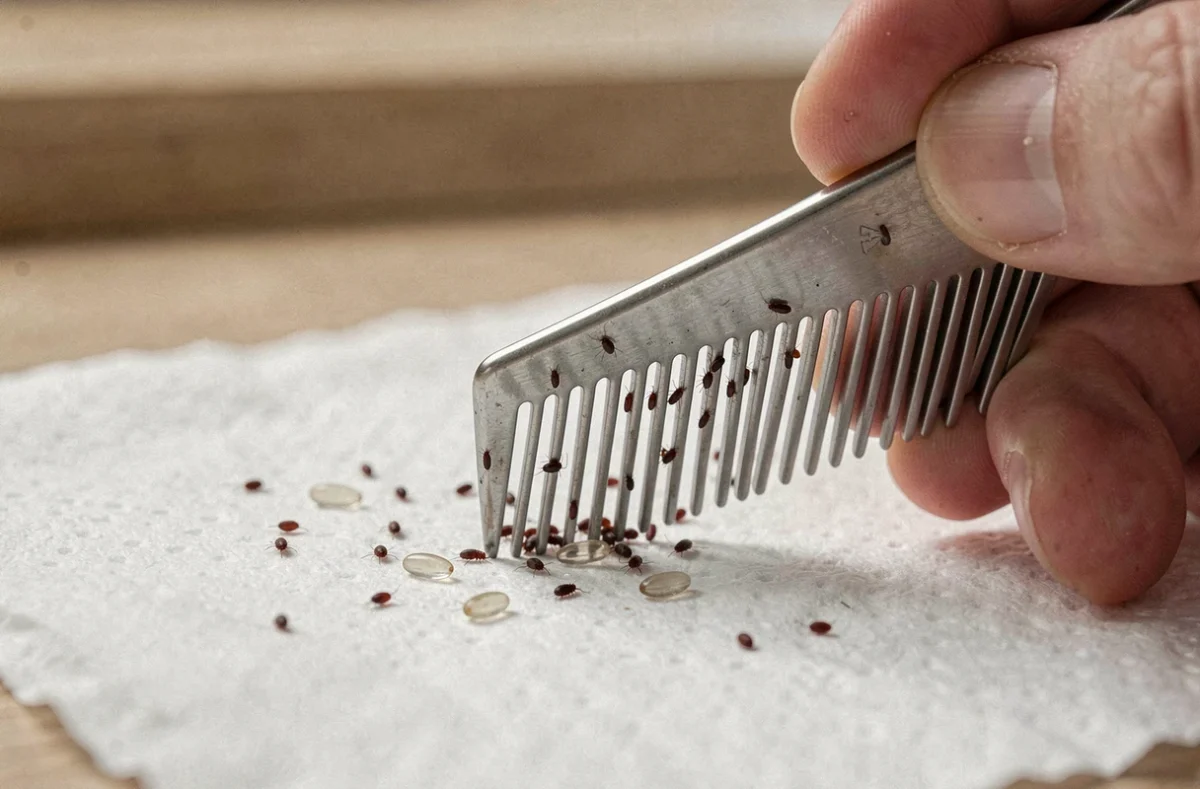
The fine comb is not only used to remove parasites. It is also the most reliable diagnostic tool after a treatment. The procedure relies on a methodical pass, strand by strand, on wet hair.
The areas to inspect first are the nape of the neck and behind the ears, where the scalp temperature is highest and where lice tend to concentrate. Each pass of the comb should be followed by wiping on a white paper or light fabric to examine what has been removed.
- Immobilized lice, dark brown, that do not react to touch: probably dead.
- Lice that move on the paper, even slowly: infestation still active.
- Only white nits, with no mobile lice: treatment likely effective, but a check a few days later remains useful to rule out a late hatching.
Itching may persist for several days after the end of an infestation. It results from the skin’s reaction to past bites and does not prove that lice are still alive. Relying on itching to decide on re-treatment often leads to unnecessary applications.
When doubt persists after two treatments
A louse found alive after a first treatment does not necessarily imply resistance to the product. The most common explanation is incorrect application (insufficient exposure time, too little quantity, hair poorly saturated) or recontamination by the environment between the two applications.
If living lice are still present after two correctly applied treatments according to the instructions, medical advice becomes necessary. The doctor may then recommend a product based on dimethicone, which acts by physically suffocating the parasite and does not encounter the same resistance phenomena as conventional insecticides.
The diagnosis always relies on the presence of a living louse, not on isolated nits or residual itching. It is this unique criterion that determines whether an infestation is active or resolved.