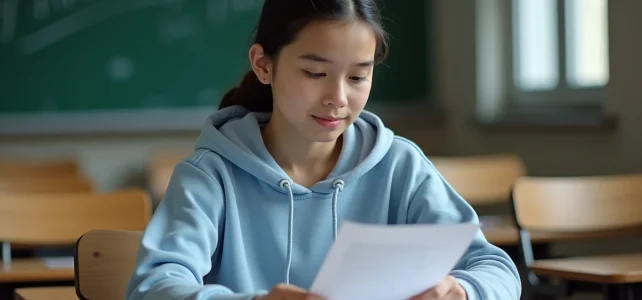
The second year of general education is often seen as a pivotal year, and the quarterly reports generate their share of anxiety. A student with an average of 11 frequently finds themselves in doubt, sometimes pushed by their surroundings to consider this result as insufficient. Institutional data tells a completely different story.
Average in the second year of general education: what the official texts say
No regulatory text sets a numerical threshold for moving on to the first year of general education. Circular No. 2015-176 of October 28, 2015, published in BOEN No. 42, frames the repetition of a year and qualifies it as a measure that should remain exceptional and justified by serious academic difficulties. These difficulties correspond to averages significantly below 10, associated with deep gaps in fundamental subjects.
Related reading : Explore the Magic of the Caribbean on a Cruise: An Unforgettable Adventure
A student with an average of 11 is therefore above the threshold where the institution begins to worry. As the FAQ on orientation from the Academy of Versailles (updated 2024) reminds us, the class council decides on a case-by-case basis, taking into account progress, attitude, and teachers’ evaluations.
This analysis grid explains why a 11 average in the second year of general education according to Media Gaga is not alarming when the overall profile of the student shows consistency and investment.
Further reading : What does the presence of a wasp in your home reveal on a spiritual level?

Comparative table: average in the second year and pathway to the baccalaureate
The Statistical Benchmarks and References from the Ministry of National Education allow us to situate the actual trajectories of students in general and technological second year.
| Average profile in the second year | Passage to the first year | Obtaining the baccalaureate (3 or 4 years) |
|---|---|---|
| Below 10 | Frequently refused or redirected | Variable, often after redirection |
| Between 10 and 12 | Granted in the majority of cases | Large majority obtains the baccalaureate |
| Above 12 | Almost systematic | Very high success rate |
An average of 11 places the student in the range where passage to the first year is generally granted and where success in the baccalaureate remains the norm. Ministerial reports never link success in the baccalaureate to a level like “15 in the second year”.
Gap between perception and reality: why 11 is wrongly concerning
The negative perception of an average of 11 stems from a phenomenon well documented by the teachers themselves. A discussion thread on the Neoprofs forum illustrates the mechanism: in middle school, subjects like music, visual arts, or technology often show class averages above 15. These grades inflate the overall average in the third year.
The arrival in the second year removes these subjects with high averages. The mechanical drop in the overall average between the third and second years does not reflect a regression of the student. It reflects a change in the evaluation perimeter.
What the class council really looks at
The class council does not limit itself to the arithmetic average. Several elements weigh in the decision on orientation:
- The progress between terms, even modest: a student who moves from 10 to 11 sends a positive signal that the council values
- Grades in core subjects (French, mathematics, history-geography) count more than an overall average dragged down by a single discipline
- Teachers’ qualitative assessments on attitude, participation, and work capacity influence the decision as much as the numbers
A profile with an average of 11 and positive evaluations along with an upward trend passes without difficulty into the first year of general education in the vast majority of institutions.
Second year of general education and choice of specialties: the average does not dictate everything
The reform of the baccalaureate has replaced the series (S, ES, L) with a system of specialties chosen at the end of the second year. This change alters the interpretation of an average of 11.
A student with an average of 11 can very well have 13 or 14 in the subjects they wish to pursue as specialties. The choice of specialties is based on results by subject, not on the overall average. A strong literary profile with a weakness in physics-chemistry remains coherent for specialties like history-geography or humanities.
The trap of comparison with selective pathways
Confusion often arises from the mixing of passage to the first year and access to selective post-baccalaureate programs. The averages required to enter a preparatory class or a PASS pathway in medicine have nothing to do with the criteria for moving on to the first year.
Comparing an 11 in the second year to the expectations of a preparatory class two years later makes no sense. The second year is a year of adaptation, and the margins for progress between the second year and the final year are considerable for most students.
Progression and work method: what matters after the second year
Data from the ministry shows that among students entering general and technological second year, a large majority reaches the baccalaureate in three or four years, including those who were not at the top of the ranking in the second year. The dynamics of progression weigh more than the starting point.
A student with an average of 11 in the second year who identifies their gaps and adjusts their work methods has two full years to consolidate their record. The first and final years offer a framework where specialization allows them to capitalize on their strengths.
The average in the second year of general education remains one indicator among others. It neither predicts failure nor success. An 11 accompanied by consistency, engagement, and a coherent orientation project constitutes a perfectly viable foundation for the continuation of the high school journey.